
When a product is new or has been reformulated, adding a “New” flash to the packaging seems like an obvious way to get shoppers’ attention.
But does it actually work?
Our packaging research suggests the answer is: not necessarily.
While “New” is a powerful and familiar cue, shoppers don’t necessarily notice it when it appears on a package. In a busy retail environment, packaging has only a brief opportunity to communicate, and shoppers typically focus on just a few key elements.
So before adding another callout to your pack, it’s worth asking a more important question:
Will shoppers actually see it?
How much attention does packaging really get?
Shoppers rarely examine every element of a package. Instead, they quickly scan the pack and focus on the elements that stand out or are most relevant to their shopping mission.
At Explorer Research, we’ve found that shoppers typically review only two or three primary elements on a package. We refer to this as the Explorer Rule of 3.
That means every element of your packaging needs to earn its place.
A “New” flash may communicate an important message, but if it isn’t one of the elements shoppers notice, it isn’t doing much to influence the shopping decision.
Why “New” isn’t always noticed
There are two important reasons a “New” flash can get overlooked.
1. Shoppers process familiar cues quickly
The word “New” is highly familiar to shoppers. We have learned to recognize it as a quick visual cue that signals a change or update.
That familiarity can actually work against the message.
Rather than consciously stopping to read and process the word, shoppers may process it automatically as they scan the package.
This is consistent with the way much of our everyday decision-making works. As Daniel Kahneman describes in his work on System 1 thinking, many decisions are made quickly and automatically rather than through deliberate, conscious analysis.
In other words, shoppers may recognize “New” without necessarily paying much attention to it.
2. Location and visual prominence matter
A packaging element can only influence shoppers if they notice it.
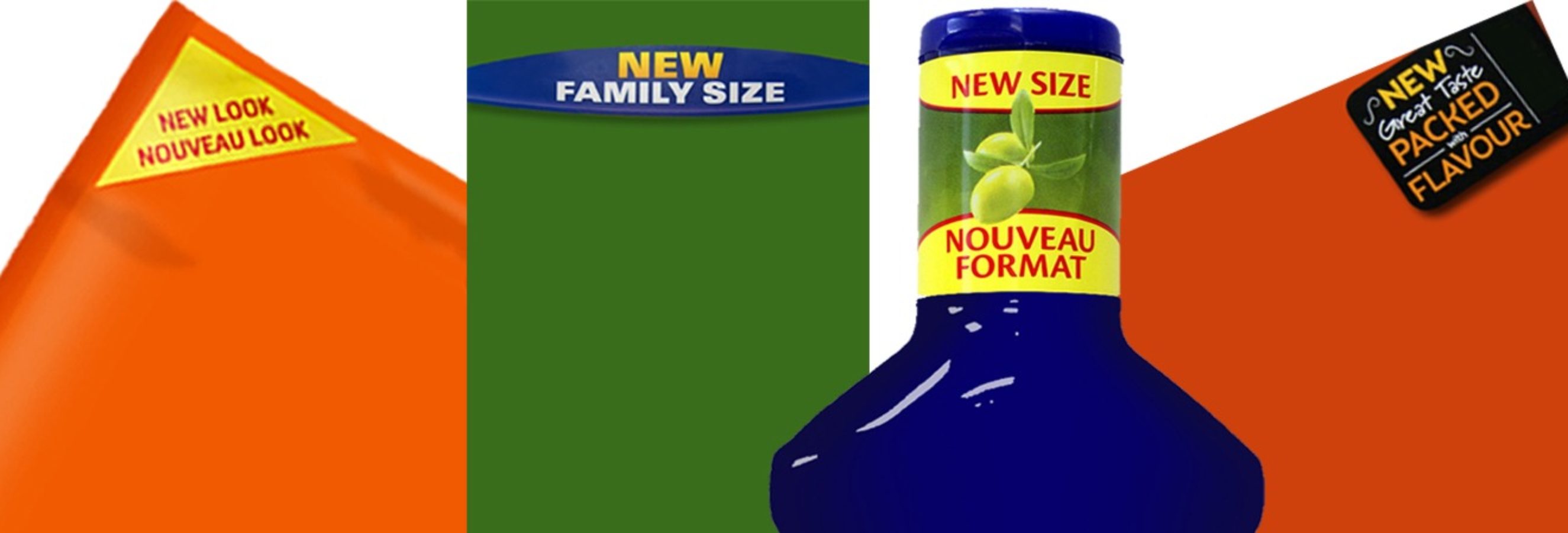
Our eye-tracking research has shown that the typical locations used for “New” flashes—such as the upper corners of a package—may receive relatively little attention.

Simply putting “New” on the pack isn’t enough.
The question is whether the claim has enough visual prominence to break through.
What does eye tracking tell us?
We tested several different approaches to displaying “New” flashes on packaging to understand how effectively shoppers noticed them.
The results varied considerably.
Across the packages we tested, “New” flashes were viewed between 19% and 62% of the time.
By comparison, brand viewing on packages was much higher, at approximately 94%–100%.
That gap is important.
It demonstrates that simply including a “New” flash doesn’t guarantee that shoppers will see it.
The design and placement of the flash can make a significant difference.
What makes a “New” flash stand out?
Our research identified three key principles for improving the visibility of “New” claims on packaging.
1. Size matters
If the “New” message is important, don’t make it too small.
A larger flash is more likely to attract visual attention than a small, easily overlooked callout.

Of course, increasing the size shouldn’t come at the expense of the overall packaging hierarchy. The goal is to make the message noticeable—not to create visual clutter.
2. Use contrast
Contrast helps attract the eye.
Using colours or design elements that contrast with the surrounding package can make a “New” flash more visually distinctive.
If the flash blends into the rest of the package, shoppers may simply scan past it.
3. Keep the message simple
A “New” flash should communicate its message quickly.
Avoid adding unnecessary information or competing messages within the same callout.
A simple, single-minded communication reduces the cognitive effort required to process the message and makes it easier for shoppers to understand at a glance.
Should you put a “New” flash on your packaging?
Not necessarily.
The answer depends on how important the “new” message is, where it appears, and whether it has enough visual impact to become part of the package’s primary communication hierarchy.
If the “New” claim is strategically important, it should be treated as more than an afterthought.
Instead of simply adding a small badge to the corner of the package, consider:
- How large should the “New” claim be?
- Where should it be positioned?
- Does it contrast with the rest of the package?
- Does it compete with the brand or other key claims?
- Will shoppers notice it during a quick shelf scan?
- Does the overall package have a clear visual hierarchy?
These are questions that packaging research and eye tracking can help answer.
Sometimes, louder is better
If you’re not willing to make the “New” message prominent on the package, another option is to communicate the change elsewhere.
Point-of-sale materials, displays, shelf signage and other shopper marketing can help reinforce the message.
The key is to make sure the communication reaches shoppers at the right point in their shopping journey.
Ultimately, effective packaging isn’t about putting more information on the pack.
It’s about making sure the right information gets noticed.
The Bottom Line
A “New” flash can be a valuable packaging tool—but simply putting the word “New” on a package doesn’t mean shoppers will see it.
Our eye-tracking research found that visibility of “New” flashes varied from 19% to 62%, depending on how they were designed and presented.
If you’re going to use a “New” flash, make it:
- Large enough to be noticed
- Contrasting enough to stand out
- Simple enough to process quickly
Most importantly, make sure it earns a place among the primary elements of your package.
Because when shoppers only look at a few elements, every package communication needs to count.
Want to know whether your packaging gets noticed?
Explorer Research uses eye tracking and other neuroscience-based research techniques to understand how shoppers actually interact with packaging.
Our packaging research can help identify which elements shoppers notice, which messages get overlooked, and how packaging can be optimized to communicate more effectively at the shelf.